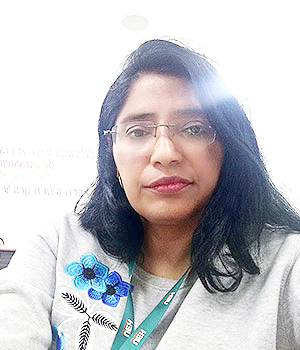
Dr. Lubna Naz
Director
Email: lnaz@iba.edu.pk
Lubna Naz is a Professor in the Department of Economics at IBA Karachi. She holds a Ph.D. in Economics from the Pakistan Institute of Development Economics, Islamabad. With over 20 years of experience in teaching and research, she has projects spanning various domains, including climate change, human capital, social security schemes for home-based workers, vulnerability mapping of disaster-prone regions, and WASH, in coordination with national and international organizations. She contributes to the capacity building of early-career faculty and researchers as a trainer in quantitative methods in climate data and health in collaboration with international organizations, including USAID, Colorado Boulder University USA, Reading University UK, and ICIMOD. She is a distinguished member of the Expert Panel on Data Integration Community in Asia and Pacific-United Nations and a member of the review panel of research projects at the Higher Education Commission of Pakistan. She has earned several fellowships as a team lead from prestigious organizations, including USAID, the DHS program, IZA, and ICIMOD. She has presented her research at prominent institutions such as the World Bank, IMF, IHEA, PAA, and UNFPA.

Dr. Jazib Mumtaz
Research Fellow
Email: jazib@iba.edu.pk
Jazib Mumtaz is an applied economist and social scientist with a strong focus on welfare economics, income distribution, and trade policy research. He holds a PhD from SZABIST Karachi and brings over two decades of combined academic and industry experience, having worked with national and multinational organizations on diverse business management strategies and policy-driven research initiatives. He has served as an Economist at the Karachi Chamber of Commerce and Industry (KCCI) and the Federation of Pakistan Chambers of Commerce and Industry (FPCCI), where he led comprehensive research on trade agreements for the Ministry of Commerce. He holds a certification in Computable General Equilibrium (CGE) Modelling from Purdue University, Macroeconomic Forecasting from the International Monetary Fund (IMF), and Inequality Measurement and Analysis from the University of Florence, which complements his expertise in applied econometrics and economic modelling. With over a dozen publications to his name, he continues to advance data-driven insights on trade dynamics, economic efficiency, and the socioeconomic effects of government interventions, advocating for evidence-based policymaking and inclusive development in Pakistan.

Sher Muhammad
Research Projects and Engagement Lead
Email: shermuhammad@iba.edu.pk
Sher is a political economist and applied researcher with a focus on empirical, solution-oriented policy work. He completed his Master's at New York University on a Fulbright Scholarship, with a concentration in political economy and quantitative methods. His research interests lie in behavioral economics, quantitative research, and evidence-based policymaking.
Before joining CBER, he worked with the Center on International Cooperation (CIC), an international think tank in New York that bridges policy practitioners at the United Nations and the academic community. He contributed to seven projects there, all centered on reducing inequality and building people-centered policy models grounded in evidence. This work ranged from solar energy initiatives in Seoul, South Korea, to Project Robin Hood, a bottom-up city governance model in Melville, Australia. He also worked with the Permanent Mission of Pakistan to the United Nations during the 79th session of the General Assembly, supporting the team as an economic advisor for its engagement with the UN Economic and Social Council (ECOSOC). Alongside this, he served as a Teaching Assistant at NYU for Econometrics and Time Series Analysis and Doing Political Economy.
